

Introduction
Getting sick or injured in a foreign country can be stressful, especially when you're unfamiliar with the healthcare system or don't speak the local language.

The good news is that Korea has a modern healthcare system with affordable medical care and many hospitals and clinics that regularly serve international patients.

This guide will help you understand where to go, what to expect, and how to prepare for your visit.
Clinic, Hospital, and Emergency Room
First, identify if your symptom(s) or condition(s) require you to visit a: 1) Clinic
2) Hospital
3) Emergency Room1) Clinics (의원)
For common medical concerns such as:Cold or flu symptomsSore throatEar infectionsSkin conditionsMinor injuriesAllergiesPrescription refills
Most clinics accept walk-ins and can often see patients the same day.2) Hospital (병원)
For:

More complex medical concerns
Specialist consultations
Advanced testing
Ongoing treatment

Large hospitals may require appointments depending on the department.
3) Emergency Room (응급실)
For:Severe injuriesDifficulty breathingChest painMajor bleedingLoss of consciousnessMedical emergencies
The number for Medical Emergencies in South Korea is 119.Which Clinic Should You Visit?
One of the most common challenges international students face is identifying the correct type of clinic.Below is a chart of different type of clinics and what they specialize in: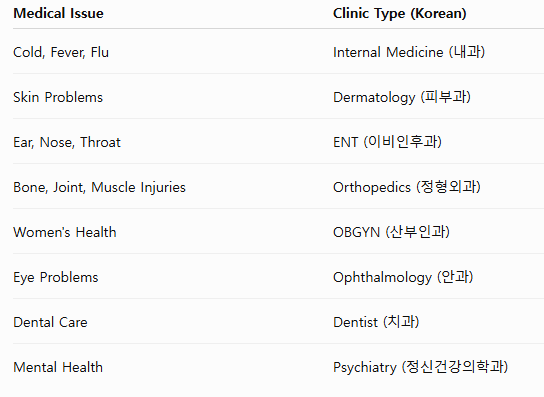
If you're unsure where to go, contact Univera and we'll help point you in the right direction.What Should You Bring?
The following are the documents or information you will need in order to get the treatment you need.1. Passport or Alien Registration Card (ARC)
2. Korean National Health Insurance (NHI) Card (if applicable)
3. Private International Insurance Information (if applicable)
4. Medical Records (if applicable)Please note that when providing medical records, most clinics and hospitals will require the document(s) to be in English or translated into Korean.What If I Don’t Speak Korean?
Many international students use translation apps such as Papago during their hospital visits.

In addition, some clinics and hospitals offer:

- Bilingual staff
- International patient centers
- Interpretation support

However, for the clinics that do not have this capacity, language barriers can still create challenges.

Some clinics may have limited English-speaking staff, while others may be unable to accommodate non-Korean speakers due to communication concerns during medical consultations and treatment discussions.

As a result, some international students report difficulty scheduling appointments, explaining symptoms, or identifying clinics that can comfortably communicate in English.

If you're unsure whether a clinic can accommodate English speakers, Univera can help verify before your visit.
What Happens During the Visit?
1) Check-In
Provide your Alien Registration Card (ARC) or Passport to confirm identity.2) Consultation
Describe your symptoms, duration, current medications you are taking, etc.3) Diagnosis
The doctor will evaluate your condition and discuss treatment options.4) Payment, Prescription, and Pharmacy
The clinic will usually print and give you the prescription paper at reception after the consultation alongside with payment.

Most Korean clinics do not dispense medications directly. Instead, prescriptions are filled separately at a pharmacy, which is often located near the clinic or hospital.
How Much Does It Cost?
Cost of medical services in Korea can vary depending on
 - Insurance status
 - Clinic type
 - Treatment required
 - Additional testing or procedures needed

With the Korean National Health Insurance (NHI):
 - Basic clinic visits are often relatively affordable.
 - Medications are usually partially covered.
 - Many routine medical concerns can be addressed at a reasonable cost.

Without NHI:

 - Costs are generally higher but still often lower than many Western countries.
 - Patients are responsible for the full cost of consultations, tests, and medications.
Before Your Visit
If cost is a concern, it is recommended that students contact the clinic directly in advance to confirm consultation fees, treatment costs, and appointment requirements.Need Help?
If you're unsure where to go, how to make an appointment, or whether a clinic can accommodate English speakers, Univera is here to help.